
The demand for smart homes is rapidly growing across the United States. Homeowners desire energy-efficient solutions that make life easier. This includes solutions for climate control, security systems, and connected lighting. At first glance, this seems like a great chance for smart home businesses to expand.
But behind the scenes, many growing businesses are struggling. Leads are coming in from multiple channels. Installations are getting delayed. Support teams are overwhelmed. Follow-ups are inconsistent. What started as a promising growth phase quickly turns into operational stress. The problem isn’t demand. The problem is scale. And without automation, scale becomes chaos.
Why do manual processes stop working as smart home businesses grow?
Most smart home companies start small. When a company launches, there are a few technicians and a handful of installers. There is just a simple process to manage sales, installs, and support. In the early days, spreadsheets, phone calls, and manual tracking feel manageable. But growth changes everything for companies.
Not just for smart home companies but all industries. But let’s focus on how this industry is affected the most. More leads mean more scheduling for smart homes. More installations mean more coordination. And this is an industry where real people and their lives are involved. Safety and security come into play. A lot of people need to work together to ensure things go right for their customers.
It becomes hard to manage as more customers mean more service requests and follow-ups. Take it for granted that manual systems don’t break overnight. They break slowly and predictably. But these breaks can be identified through missed details and delayed responses. This is where a smart home automation system, combined with business process automation, becomes essential rather than optional.
How do missed follow-ups and delays hurt customer trust?
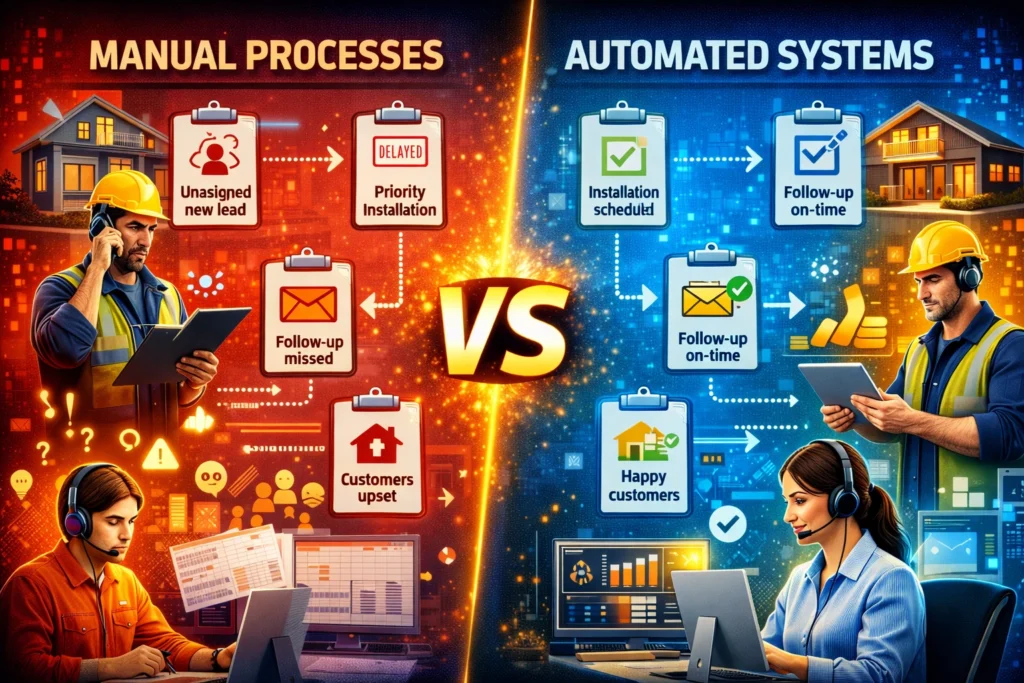
Smart home customers expect precision. If a company can automate their home, customers assume the business itself runs smoothly. When follow-ups are delayed, installation dates are unclear, or support tickets go unanswered, trust erodes quickly. Customers don’t always complain.
They leave reviews, cancel upgrades, or switch providers. Automation ensures no lead, install, or service request is forgotten. It creates consistency, which is the foundation of trust in the US market.
Why is lead handling a major growth bottleneck for smart home companies?
As businesses expand, they get more channels for growth. Websites, sponsored advertisements, recommendations, and collaborations with builders or real estate brokers provide leads. These leads frequently remain unassigned or are followed up on too late in the absence of automation.
Leads are immediately recorded and given to the appropriate team. This way, they are promptly followed up on thanks to an automated process. This system is usually linked to a smart home automation system. Without hiring extra salespeople, this lowers lead drop-off and boosts conversion.
In a competitive US market, speed often decides who wins the customer. Installation is one of the most complex parts of a smart home business. It involves technicians, equipment availability, customer availability, and sometimes third-party vendors.
Manual scheduling leads to conflicts, delays, and rescheduling headaches. Automation brings structure. Installations are scheduled based on availability. Teams receive reminders. Customers are informed automatically. This reduces errors, improves on-time installations, and keeps both technicians and customers aligned.
Why customer support becomes unmanageable without automation?
As the customer base grows, support requests grow with it. Device issues, upgrades, maintenance questions, and system updates all generate tickets. Without automation, support teams get overwhelmed. Requests are missed. Response times increase. Customer satisfaction drops.
Automation helps route support requests, track resolution times, and ensure follow-ups happen. For companies offering a smart home automation system, support quality directly affects renewals and referrals. Smart home sales don’t end with the first installation.
Customers often add more devices, upgrade systems, or expand automation to new areas of their home. The use of automation helps track customer setups, usage patterns, and service history. This makes it easier to recommend upgrades at the right time, without sounding pushy. In the US market, where customer lifetime value matters, automation turns one-time buyers into long-term clients.
Why does data visibility matter for scaling smart home companies?
Growing companies need clarity. Which services sell the most? Where are delays happening? Which teams perform best? Manual systems hide these answers. Automation brings visibility. Dashboards show sales performance and installation timelines easily. They also record support efficiency and customer satisfaction.
This allows leaders to make informed decisions in time. It is always better instead of relying on gut instinct. Growth becomes intentional, not reactive. Hiring more people isn’t always the solution. It increases costs and management complexity.
Automation handles repetitive tasks like follow-ups, reminders, updates, and reporting. Teams focus on high-value work like design, installation quality, and customer relationships. For smart home companies, this balance is critical to maintaining margins while scaling.
Why do US customers expect automation from smart home providers?
Consumers are used to seamless digital experiences. They expect timely updates, clear communication, and fast resolution. When a smart home company operates manually, the gap between what they sell and how they operate becomes obvious. Automation aligns internal operations with the promise of a smart home automation system.
It shows professionalism, reliability, and readiness to scale. Delaying automation doesn’t stop growth. It makes growth painful. Teams burn out. Customers get frustrated. Mistakes increase. Eventually, growth stalls not because of competition, but because of internal limits. Companies that automate early build systems that support growth instead of resisting it.
Final Thoughts: Is automation optional for smart home companies anymore?
Automation is no longer a future investment. It is a present requirement. For smart home companies in the US, automation protects customer experience, team efficiency, and long-term profitability. It turns growth from a challenge into an advantage.
A smart home automation system doesn’t just power homes. They do a lot more than that. When paired with automation across sales, installation, and support, it powers sustainable business growth. If growth is the goal, automation is the foundation.